Ex d flameproof enclosure: design, advantages, limitations

Application of Ex d flameproof enclosure
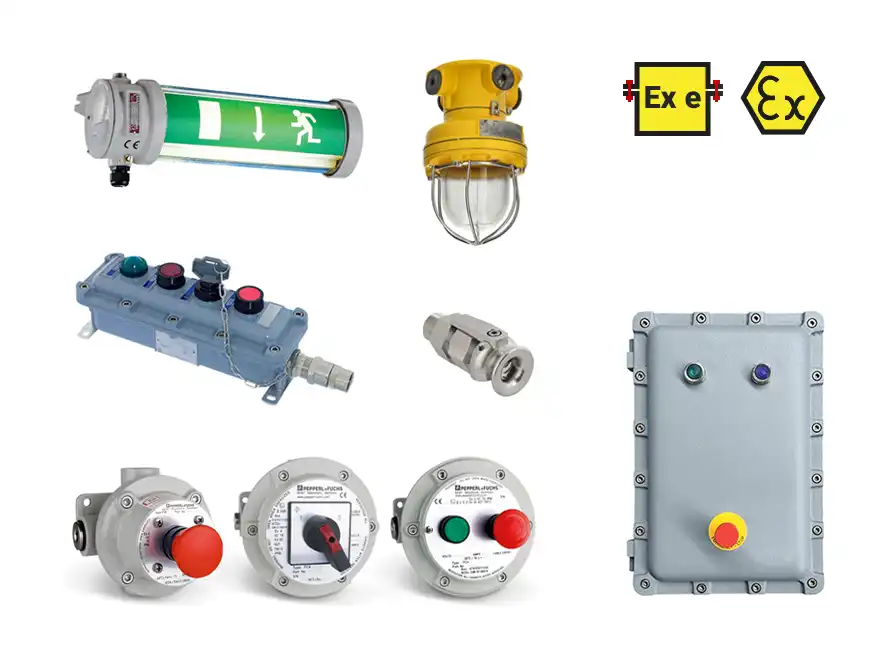
Although many topics in this article will refer to enclosures used for mounting various types of equipment, including switching, measuring, and control apparatus, it should be emphasized that this protection concept applies to a wide range of products. Below is a list of some of them:

- switches and buttons,
- limit switches,
- junction and distribution boxes,
- cable glands,
- indicator lights,
- equipment mounting enclosures,
- lighting fixtures,
- others.
Ex d – Flameproof Enclosure: Operating Principle
This protection involves the use of a special enclosure. It is allowed that an explosion may occur inside the enclosure, but it must not escape outside. However, for this protection to be effective, a series of restrictions must be met. Otherwise, the protection will be ineffective, posing a risk of a secondary explosion outside the enclosure.
Basic Assumptions of Ex d Protection:
- an explosive atmosphere can penetrate inside the enclosure,
- ordinary (non-Ex) equipment may be used inside the enclosure, and therefore ignition sources in the form of elevated temperatures or sparks may occur,
- the enclosure must withstand the pressure of the internal explosion,
- mechanical connections, especially between the enclosure and its cover, must form a so-called flame path, which will control the release of excess pressure while extinguishing flames and cooling the gases escaping outside so that they do not become a secondary ignition source for the explosive atmosphere.
Damage to the Flame Path
What happens if the flame path is damaged, e.g., by various types of pitting or scratches? The protection loses its effectiveness, which poses a risk of a secondary explosion outside the enclosure, as shown in the animation below:
- part 1/3: the explosion in an undamaged enclosure is contained within it
- part 2/3: creation of a scratch at the enclosure body-cover connection
- part 3/3: explosion transmission through the scratch outside, leading to a secondary explosion

Advantages of Ex d Protection
- Relatively low cost for typical solutions with small dimensions,
- possibility to use ordinary (non-Ex) equipment inside the enclosure, which reduces the cost of the device,
- possibility to install sparking or heating components inside the device,
- possibility to enclose high-power equipment and non-standard components that are not available in Ex versions.
Limitations of Ex d Protection
- Very high cost of purchasing medium and large-sized enclosures,
- high sensitivity of the flame path to damage (loss of protection effectiveness),
- high cost of repairing equipment compliant with IEC 60079-1 used in Europe, among other places (requires disassembly and shipping to the manufacturer) – see details in the table below,
- very high weight of the device, making installation and handling difficult,
- lack of automation to detect flame path damage, leading to higher inspection costs (requires close inspection, detailed flame path inspection),
- limited number of enclosure sizes.
Different Ex d Protection Concepts in Europe and North America
Different economic areas are based on different norms and standards. For example, in Europe, the primary document from which we derive knowledge about Ex d protection is the IEC 60079-1 standard. In the case of North America, these are the UL1203 or FM 3615 standards. As a result, there are certain differences in both terminology and key assumptions for Ex d explosion protection.
Terminology Differences
Let’s start with terminology, as its incorrect use can lead to serious errors. In Europe, devices with Ex d protection are referred to as flameproof, as per the IEC 60079-1 standard. At the same time, devices intended for use in explosive zones (regardless of the protection they have) are commonly referred to as explosion-proof devices.
On the other hand, in North America, the term explosion-proof is reserved exclusively for devices with Ex d protection.
Conceptual Differences
The differences in the terminology of devices with Ex d protection between Europe (flameproof) and North America (explosion-proof) are just the beginning of the list of discrepancies. Much more significant differences exist in the approach to the Ex d protection concept itself – some of which are presented in the table below.
| Ex d Enclosure Types According to Different Standards | ||
| Nomenclature | Explosion proof (explosion-proof) | Flameproof (flame-resistant) |
| Region | North America and other areas using the following standards | EU and other regions based on the following standard |
| Standard | UL1203 or FM 3615 | IEC 60079-1 |
| Construction | Requirement for minimum wall thickness (heavy). Different approach to: seals, joints, flame paths, openings, plugs, corrosion protection, additional tests | No requirements for minimum wall thickness (lighter) |
| Drilling holes in the enclosure | User, EPC, possibility of on-site drilling | Manufacturer, repair facility |
| Ingress Protection | Ingress protection and weatherproofing requirements in the above standards. | According to another standard IEC 60529 |
| Pressure Testing | 4 x explosion pressure for 10 seconds 10 explosion pressure tests 10 additional tests with 75% vent blockage if applicable | 1.5 x explosion pressure 5 tests with different gas mixtures |
| Temperature Rise | Not considered | Quantity, arrangement, power, enclosure size, etc., must meet requirements to ensure the device does not exceed the specified temperature class (appropriate calculations required) |
| Sold Empty | Yes | Only to other manufacturers (certificate U), to end customers only a finished product with equipment |
Ex d Enclosure with a Decompression Panel and Flame Arrester – A New Concept
A few years ago, a new concept of Ex d enclosure appeared on the market, the main advantage of which was supposed to be the reduction of weight, and thus the cost of the device. The new concept involved the use of a thin-walled enclosure with so-called flameless explosion venting. Its task is to reduce the pressure inside the enclosure by directing the explosion effects to the environment without the risk of transmitting the explosion outside. This concept, known for decades, has so far been used exclusively to protect process equipment such as silos, dust collectors, bucket elevators, etc.

How Ex d Enclosure with Flameless Explosion Venting Works
This solution involves mounting a so-called decompression panel on one of the enclosure walls, which, when the explosion pressure reaches +/- 0.1 bar g, is deliberately ruptured, directing the explosion effects to the environment. However, to ensure this is done safely, behind the panel (viewed from the outside) is a kind of filter made of a suitable number of layers of steel mesh. Its role is to:
- extinguish flames,
- cool the exhaust gases,
- disperse the explosion pressure.
Residual pressure and exhaust gases cooled below the auto-ignition temperature of the explosive atmosphere escape to the environment.
Despite the interesting concept, this solution has not yet gained recognition among users, remaining just a curiosity.
Combining Ex d and Ex e Enclosures
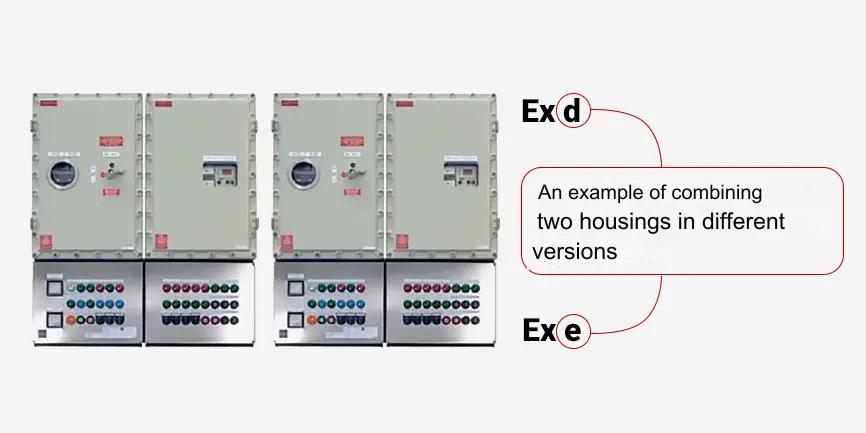
Ex d protection is often used in combination with other protection methods, such as Ex e. Below, we see the combination of an Ex d enclosure with an Ex e enclosure, which most often allows for lowering the cost of the solution and increasing its functionality. At the same time, customers often decide to replace flameproof (Ex d) enclosures with reinforced Ex e enclosures, which in most cases provide a lower price and easier maintenance while ensuring the same or higher level of safety.